We are now accepting new patients | Find out more >>
Visit us: 20 Oswald Road, Oswestry, Shropshire, SY11 1RE
Call us: 01691 652424

Extending the Life of your Teeth: Why We Recommend Biodentine™
OHDP Team
Share
Why Biodentine™?
Biodentine™ is different to other dental materials and can often replace, or prevent, other more invasive treatments, such as root canal treatment.
Understanding tooth decay
Your teeth are covered in a tough outer shell called ‘enamel’, but this can wear away over time, often due to excessive amounts of sugar which react with bacteria in the mouth. This can cause tiny holes in the enamel and is the start of a ‘cavity’ or ‘caries’.
This cavity then exposes the softer dentine underneath. Dentine is more vulnerable to wear from bacteria and acid and has tiny tubes that directly link with the pulp, which houses the nerves of the tooth, causing sensitivity.
If the cavity goes untreated then the decay continues and the inflammation travels through the pulp, and you get pain – this is known as “pulpitis”.
This inflammation can even travel down to the bone and the end result will be root canal treatment (where your tooth will no longer be vital/alive) or extraction.
How does Biodentine™ work?
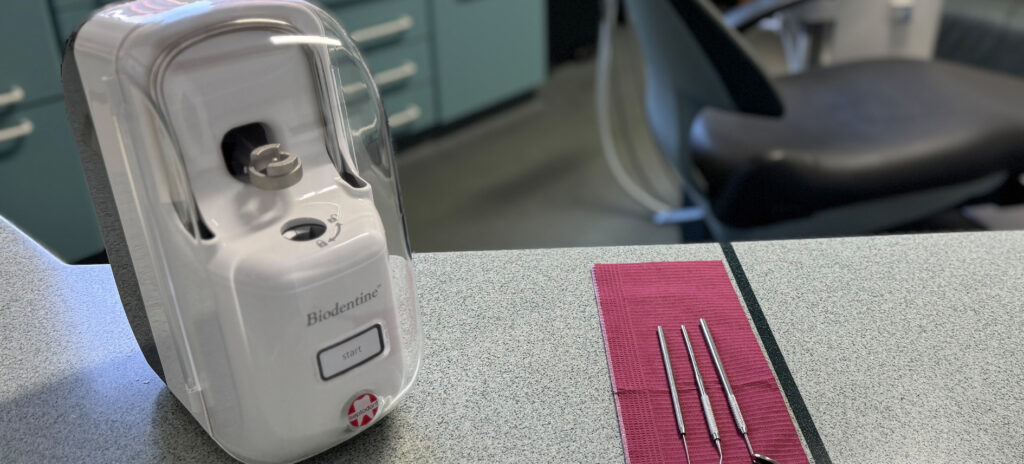
Biodentine™ is mostly made of tricalcium silicate powder which, when mixed and set, forms a material very similar to natural dentine. In fact, while other dental materials are simply “fillings”, Biodentine™ can remineralise and repair your tooth, even when the pulp has become exposed within the cavity. It has been
clinically proven to infiltrate and seal the tiny tubes that link to the nerve and, therefore, can reduce pain immediately. In most cases, your tooth will remain alive and in good condition, thanks to the unique properties of Biodentine™.
Biodentine™ is made in France by Septodont, the World’s leading dental pharmaceutical company. But Biodentine™ contains no drugs. In fact, it is completely bioactive and biocompatible, which means that it works and reacts with the cells of your body. That’s what makes it unique. Biodentine™ took many years to develop and finally offers some patients an alternative to root canal treatment. It can potentially keep your tooth alive and enable your dentist to restore the tooth. It’s a better clinical outcome, less involved and at far less expense than would have previously been required.
What happens next?
If we’ve recommended Biodentine™, then it’s because we can see significant tooth loss, possibly due to caries. Biodentine™ will re-seal the pulp, kill off any remaining bacteria and will fill the tooth, permanently replacing all of your lost dentine. Finally, you will need a layer of hard-wearing composite filling or a crown placed over the Biodentine™ to replace enamel.
Your tooth should settle completely, if not immediately, then over the next few days. If the pulp/nerve was inflamed before the treatment the tooth may remain painful or uncomfortable for up to 10 days. We will advise on the specifics of your tooth. Please do ask us if there any questions that you may still have.
If you’ve been told you might need a root canal therapy, or you’re experiencing ongoing tooth pain, speak to us about whether Biodentine™ could be the right solution for you.
Book your appointment today and protect the health – and life – of your tooth.
Written or reviewed by Jabbar Hussain.
Dentist with over 20 years’ experience in high-end general and cosmetic dentistry.
Articles you may be interested in
April 1 2026
Why Are My Gums Bleeding? (The “Amber Warning Light” You Shouldn’t Ignore)
Introduction A patient said to me recently: “It’s probably nothing… but my gums bleed when...
Continue reading
March 25 2026
Menopause and Oral Health: What Every Woman Should Know
Menopause and Oral Health: What Every Woman Should Know A patient guide from Oswyn House...
Continue reading
March 18 2026
Dental X-rays: Why They Are Safe and Important
Many patients are surprised when their dentist recommends dental X-rays. Because they cannot see any...
Continue reading